
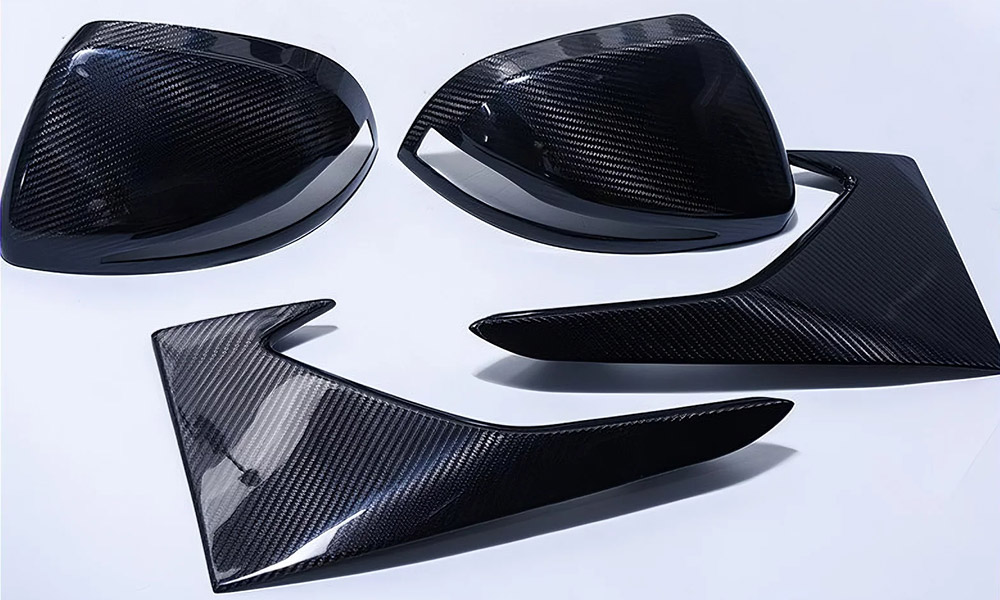
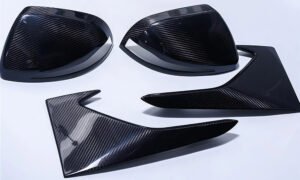
Carbon fiber has become a premium material in the automotive world, valued for being incredibly strong yet lightweight. One popular application is the exterior mirror housing, which enhances a vehicle’s aesthetics and performance. But how are these high-end parts actually produced? And is the manufacturing process similar to that of standard plastic mirror housings?
The short answer is no—the methods are fundamentally different. Unlike plastic injection molding, carbon fiber parts are created using a meticulous, hands-on process. Here’s a breakdown of how it’s done:
🛠 1. Design & Digital Modeling
It all starts with a detailed 3D digital model designed specifically for the vehicle make and model. Using CAD (Computer-Aided Design) software, engineers define every contour, curve, and mounting point to ensure a perfect fit.
📌 2. Mold Fabrication
A high-precision mold, usually made from polished fiberglass or metal, is crafted based on the digital design. This mold must be flawless—it defines the final shape and finish of the mirror housing.
⚙️ 3. Layup: Placing the Carbon Fiber
Sheets of carbon fiber pre-impregnated with resin (prepreg) are carefully laid into the mold. The orientation of each layer is strategic—it determines the final strength and flexibility of the part.
🔁 4. Resin Infusion & Debulking
For some processes, additional resin is infused to fully saturate the fibers. The stack is then vacuum-sealed to remove air bubbles and compact the layers—a critical step to prevent weaknesses.
♨️ 5. Curing
The mold is placed in an autoclave or oven where heat and pressure cure the resin. This transforms the soft layered material into a rigid, high-strength composite structure.
✨ 6. Trimming, Finishing & Polishing
Once demolded, the housing is trimmed to its final shape. It’s then sanded, clear-coated, or painted to achieve a glossy, UV-resistant finish that highlights the iconic carbon weave.
Carbon Fiber vs. Plastic: What’s the Difference?
While plastic housings are mass-produced quickly using injection molding, carbon fiber parts are manufactured using a labor-intensive process that emphasizes quality over speed. The result is a part that is not only lighter and stronger than plastic but also adds a distinctive, high-performance look.
Ideal for luxury and sports cars, carbon fiber mirror housings offer a blend of performance and style that plastic simply can’t match.
Key Takeaways:
– Carbon fiber mirror shells are handmade using composite layup techniques.
– They are lighter, stronger, and more visually distinctive than plastic versions.
– The process is more complex and cost-intensive than injection molding.




 English
  German
  French
  Portuguese
  Japanese
  Russian
  Italian
  Spanish
  Arabic